Article · Wikipedia archive · Last revised Jul 12, 2026

Legendre chi function

In mathematics, the Legendre chi function is a special function whose Taylor series is also a Dirichlet series, given by

Last revised
Jul 12, 2026
Read time
≈ 4 min
Length
1,000 w
Citations
2
Source

In mathematics, the Legendre chi function (named after Adrien-Marie Legendre) is a special function whose Taylor series is also a Dirichlet series, given by χ ν ( z ) = k = 0 z 2 k + 1 ( 2 k + 1 ) ν . {\displaystyle \chi _{\nu }(z)=\sum _{k=0}^{\infty }{\frac {z^{2k+1}}{(2k+1)^{\nu }}}.}

Legendre chi function source ↗

As such, it resembles the Dirichlet series for the polylogarithm, and, indeed, is trivially expressible as the odd part of the polylogarithm χ ν ( z ) = 1 2 [ Li ν ( z ) Li ν ( z ) ] . {\displaystyle \chi _{\nu }(z)={\frac {1}{2}}\left[\operatorname {Li} _{\nu }(z)-\operatorname {Li} _{\nu }(-z)\right].}

The Legendre chi function appears as the discrete Fourier transform, with respect to the order ν, of the Hurwitz zeta function, and also of the Euler polynomials, with the explicit relationships given in those articles.

The Legendre chi function is a special case of the Lerch transcendent, and is given by χ ν ( z ) = 2 ν z Φ ( z 2 , ν , 1 / 2 ) . {\displaystyle \chi _{\nu }(z)=2^{-\nu }z\,\Phi (z^{2},\nu ,1/2).}

Identities

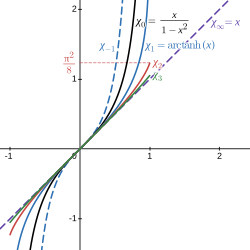
χ 1 ( x ) = x ( 1 + x 2 ) ( 1 x 2 ) 2 {\displaystyle \chi _{-1}\left(x\right)={\frac {x\left(1+x^{2}\right)}{\left(1-x^{2}\right)^{2}}}} χ 0 ( x ) = x 1 x 2 {\displaystyle \chi _{0}\left(x\right)={\frac {x}{1-x^{2}}}} χ 1 ( x ) = arctanh ( x ) = 1 2 ln ( 1 + x 1 x ) {\displaystyle \chi _{1}(x)=\operatorname {arctanh} (x)={\frac {1}{2}}\ln \left({\frac {1+x}{1-x}}\right)} χ 2 ( x ) = 0 x arctanh ( t ) t d t {\displaystyle \chi _{2}(x)=\int _{0}^{x}{\frac {\operatorname {arctanh} (t)}{t}}\mathrm {d} t} χ ( x ) = x {\displaystyle \chi _{\infty }(x)=x} d d x χ ν ( x ) = χ ν 1 ( x ) x {\displaystyle {\frac {\mathrm {d} }{\mathrm {d} x}}\chi _{\nu }(x)={\frac {\chi _{\nu -1}(x)}{x}}} d d x χ 2 ( x ) = arctanh ( x ) x {\displaystyle {\frac {\mathrm {d} }{\mathrm {d} x}}\chi _{2}(x)={\frac {\operatorname {arctanh} (x)}{x}}} χ 2 ( x ) + χ 2 ( 1 / x ) = π 2 4 i π 2 ln | x | {\displaystyle \chi _{2}(x)+\chi _{2}(1/x)={\frac {\pi ^{2}}{4}}-{\frac {i\pi }{2}}\ln |x|} χ 2 ( x ) + χ 2 ( 1 x 1 + x ) = π 2 8 + ln ( x ) arctanh ( x ) , x ( 0 , 1 ) {\displaystyle \chi _{2}(x)+\chi _{2}\left({\frac {1-x}{1+x}}\right)={\frac {\pi ^{2}}{8}}+\ln(x)\operatorname {arctanh} (x),\quad x\in (0,1)}

Special Values

It takes the special values:

χ 2 ( 1 ) = π 2 8 {\displaystyle \chi _{2}(1)={\frac {\pi ^{2}}{8}}} χ 2 ( 1 ) = π 2 8 {\displaystyle \chi _{2}(-1)=-{\frac {\pi ^{2}}{8}}} χ 2 ( 2 1 ) = π 2 16 1 4 ln 2 ( 2 + 1 ) {\displaystyle \chi _{2}({\sqrt {2}}-1)={\frac {\pi ^{2}}{16}}-{\frac {1}{4}}\ln ^{2}({\sqrt {2}}+1)} χ 2 ( 5 1 2 ) = π 2 12 3 4 ln 2 ( 5 + 1 2 ) {\displaystyle \chi _{2}\left({\frac {{\sqrt {5}}-1}{2}}\right)={\frac {\pi ^{2}}{12}}-{\frac {3}{4}}\ln ^{2}\left({\frac {{\sqrt {5}}+1}{2}}\right)} χ 2 ( 5 2 ) = π 2 24 3 4 ln 2 ( 5 + 1 2 ) {\displaystyle \chi _{2}({\sqrt {5}}-2)={\frac {\pi ^{2}}{24}}-{\frac {3}{4}}\ln ^{2}\left({\frac {{\sqrt {5}}+1}{2}}\right)} χ 2 ( i ) = i K , {\displaystyle \chi _{2}(i)=iK,}

where i i is the imaginary unit and K is Catalan's constant.1 Other special values include:

χ n ( 1 ) = λ ( n ) {\displaystyle \chi _{n}(1)=\lambda (n)} χ n ( i ) = i β ( n ) , {\displaystyle \chi _{n}(i)=i\beta (n),}

where λ ( n ) \lambda (n) is the Dirichlet lambda function and β ( n ) \beta (n) is the Dirichlet beta function.1

Integral relations

0 π / 2 arcsin ( r sin θ ) d θ = χ 2 ( r ) , 0 π / 2 arccos ( r cos θ ) d θ = ( π 2 ) 2 χ 2 ( r ) i f     | r | 1 {\displaystyle \int _{0}^{\pi /2}\arcsin(r\sin \theta )\,\mathrm {d} \theta =\chi _{2}(r),\qquad \int _{0}^{\pi /2}\arccos(r\cos \theta )\,\mathrm {d} \theta =\left({\frac {\pi }{2}}\right)^{2}-\chi _{2}(r)\qquad {\rm {if}}~~|r|\leq 1} 0 π / 2 arctan ( r sin θ ) d θ = 1 2 0 π r θ cos θ 1 + r 2 sin 2 θ d θ = 2 χ 2 ( 1 + r 2 1 r ) {\displaystyle \int _{0}^{\pi /2}\arctan(r\sin \theta )\,\mathrm {d} \theta =-{\frac {1}{2}}\int _{0}^{\pi }{\frac {r\theta \cos \theta }{1+r^{2}\sin ^{2}\theta }}\,\mathrm {d} \theta =2\chi _{2}\!\!\left({\frac {{\sqrt {1+r^{2}}}-1}{r}}\right)} 0 π / 2 arctan ( p sin θ ) arctan ( q sin θ ) d θ = π χ 2 ( 1 + p 2 1 p 1 + q 2 1 q ) {\displaystyle \int _{0}^{\pi /2}\arctan(p\sin \theta )\arctan(q\sin \theta )\,\mathrm {d} \theta =\pi \chi _{2}\!\!\left({\frac {{\sqrt {1+p^{2}}}-1}{p}}\cdot {\frac {{\sqrt {1+q^{2}}}-1}{q}}\right)} 0 α 0 β d x d y 1 x 2 y 2 = χ 2 ( α β ) i f     | α β | 1 {\displaystyle \int _{0}^{\alpha }\int _{0}^{\beta }{\frac {\mathrm {d} x\,\mathrm {d} y}{1-x^{2}y^{2}}}=\chi _{2}(\alpha \beta )\qquad {\rm {if}}~~|\alpha \beta |\leq 1}

References

References

  1. Weisstein, Eric W. "Legendre's Chi-Function". MathWorld. Wolfram Research. Retrieved 2025-12-08.